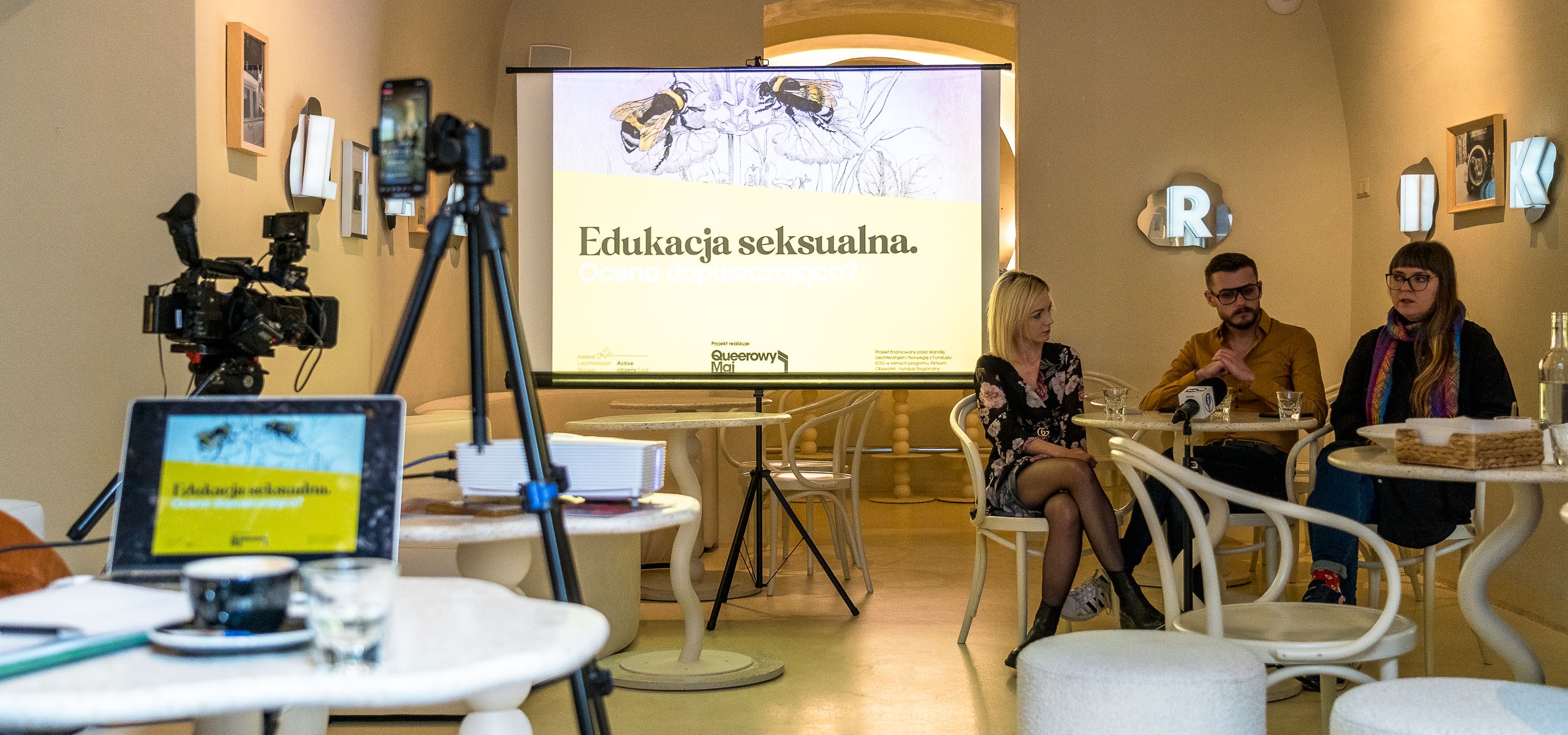
Accurate, led by experts, open to diversity, safe, but above all – present! This is the kind of sex education we need in Poland! The Queer May Association presented the first results of an ongoing study, which also includes an analysis of sex education textbooks. Will the change of curators be a good moment to talk about sex education in Poland?
In recent years, sex education has been supposed to cause fear and panic, “sexualize” young people, and take away the agency of parents and guardians. What does it look like today? What do young people and parents expect, and how do teachers fit into this whole discussion? The Queer May Association is currently conducting a study to assess the state of sex education in Poland.
Let us recall that a 2019 IBRiS survey found that 80% of our compatriots want sex education in schools, with 47% believing that it should be available from primary school onwards. Poles also understand that young people should not get their information about sexuality from the internet and their peers. In 2020, the Queer May Association, while examining the situation of LGBTQIA people in Krakow’s secondary schools, also asked about Family Life Education classes – two-thirds of respondents did not decide to participate in these classes, and 54.6% of those who did participate encountered topics such as LGBTQIA during them.
What do we learn from the latest research and analysis by the Queer May Association? Sex education must be compulsory! In the age group where young people should be most interested in sex education, i.e., around 15 years of age, the number of those attending sex education classes drops from 55% to 17%. .
“We see a clear trend of declining interest in family life education classes. Since the beginning of Minister Czarnek’s term, the number of students attending sex education classes has fallen by 1/5. Due to ideological bias, it does not contain the content that should be included and does not teach the people who should be educated. The course is unwanted by everyone – students, parents, and schools. Keeping this subject in its current form is maintaining a fiction” – says Artur Maciejewski of the Queer May Association.
Anna Tereszko, who, among other things, conducted an analysis of Family Life Education textbooks, emphasizes that “We are not really in a position to assess sex education in Poland because there is simply no such education! The very name Family Life Education indicates that the emphasis is on marriage, family, religious and national values, and tradition. The most important thing is procreation, not sexual health as understood in the WHO guidelines”. The psychologist and doctor draw attention to stereotypes and archaic and stigmatizing knowledge, e.g. in the context of sexually transmitted infections.
The topic of sex education is also particularly relevant in Krakow and the Małopolska region because of Barbara Nowak. Of course, we eagerly await a change in the position of superintendent of education, and we promise that we will also give Ms. Nowak a dignified send-off as Queer May. Let’s not waste this political and social moment, which is so special for all of us. Through our research and analysis, we want to give politicians, local government officials, but above all teachers, arguments – because reliable sex education that trusts young people can save their lives” – says Magda Dropek, president of the Queer May Association.
At the end of November, the Association will present all the results of its research and analysis during an event on sex education.
However, the collection of experiences and needs through surveys will continue until November 15:
- for students: https://www.queerowymaj.org/sex-ed/ankieta-uczniowie/
- for parents and guardians: https://www.queerowymaj.org/sex-ed/ankieta-rodzice/
- for teachers: https://www.queerowymaj.org/sex-ed/ankieta-nauczyciele/
The survey is part of a project funded by Iceland, Liechtenstein, and Norway from the EEA Funds under the Active Citizens Program – Regional Fund.